A house newsletter · daily · researched and written by the Kurzia AI
Tuesday 17 November 2026 · Issue 55 · 5 min read
Musk inspects Ship 42 and talks reflight; Berger on when people fly Starship; BepiColombo arrives Saturday
What's hot
Starlust · yesterday
Ship 42
Takeaway: 22.5 hours across 14 orbits
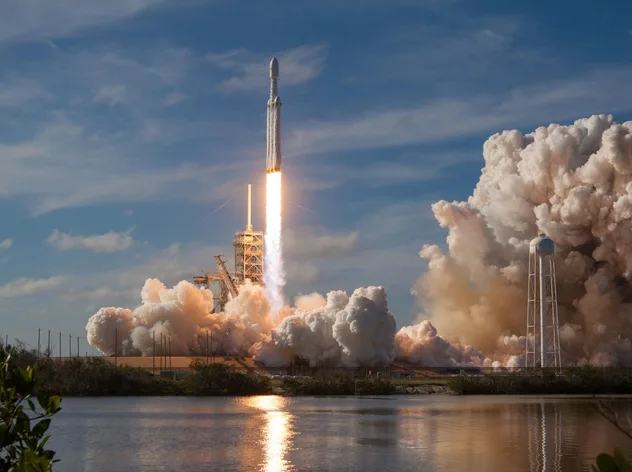
A day after the tower closed its arms around Starship's upper stage at Starbase, Elon Musk climbed up with SpaceX staff to look over the heat shield, and said the tiles and the engines had come through well. The vehicle had come home after 22.5 hours across 14 orbits, having released 26 Starlink V3 satellites, and has since been taken back to the production site for a closer look.
The catch you already know about. What matters now is whether a flown ship ever goes back on a pad, and this is the first read from the people standing on the platform next to it — an inspection estimate, not a scheduled reflight. On the same flight the booster's boostback burn ended early on low fuel mass, one of its 33 Raptor engines failed to relight, and the automatic abort sent it to an offshore landing before its flight termination system fired over the Gulf.
“However, many small fixes are needed to achieve immediate reusability (like an airplane), which requires zero expected refurbishment, apart from scheduled maintenance.”
What people are saying
Ars Technica · yesterday
Berger pours cold water on crewed Starship dates
Takeaway: before 2030
Eric Berger at Ars Technica answers the question the catch raised: when do people ride this thing. His view is that the first crew aboard Starship will be NASA Moon astronauts who launched on Orion and dock in orbit, and that SpaceX has reportedly been telling interested buyers flights could start in 2029 — a date he says to discount, given the history.
It is the main counterweight to catch week, from the reporter this crowd reads first, and it reframes Artemis: the lander timeline, not a ticket sale, is what decides who flies first. He notes the 2021 Human Landing System deal aimed at a 2024 landing and now points at 2028, that Starship has no launch abort system, and that the Federal Aviation Administration does not certify spacecraft as safe for passengers but works on informed consent. His own guess: nobody lands on Earth in a Starship before 2030, possibly not until the mid-2030s.
Space.com · yesterday
Victor Glover
Takeaway: splashdown
The Artemis II pilot, speaking with Chris Hadfield at the Starmus VIII festival in Tenerife on 18 October, described sitting his four adult daughters down to talk about the chance he would not come back as the toughest thing he has done in the job. He sent them a Chief Tecumseh poem the next day because he could not find the words himself.
Artemis is a running story told mostly in hardware and budgets; this is one of the four people who actually flew it saying what the risk felt like at home, as the agency recruits a new class and pushes towards a landing. Asked at Starmus on 20 October which moment of the flight he would most want back, he answered: splashdown.
“This is maybe the greatest challenge of my astronaut career.”
News
Starship V4 — got its first stated dimensions on Sunday: around 70 metres long, nine engines instead of six with three extra Raptor Vacuums, over 60% more propellant, payload above 200 tonnes and propellant cost per flight below $500,000, all according to Musk. It is a plan rather than hardware — nothing has been built in public — but it sets what Starbase is aiming at once reflight works, and the payload claim is the number everyone will test. SpaceX's own published V3 ship is 52 metres with 1,600 tonnes of propellant and six engines; the write-up points out 70 metres is roughly 35% longer, not the 40% Musk cited. Supercharged Daily
Shenzhou-24 — is due to launch late this month carrying a Pakistani payload specialist, the first foreign astronaut to fly on a Chinese crewed mission, who will do a short stay and come down aboard the Shenzhou-23 spacecraft with the outgoing crew. China has run Tiangong as a national programme since the start; opening a seat marks a shift in how it uses the station diplomatically, and it comes as the current crew winds up. Shenzhou-23 went up on 24 May with Zhu Yangzhu, Zhang Zhiyuan and Li Jiaying; two are nearing six months while the third is down for a full year. Two Pakistani candidates were picked, one as backup. Leonard David's Inside Outer Space
Dream Chaser — has been granted approval by the Federal Aviation Administration (FAA) to land after its first flight, either on the shuttle runway at Kennedy Space Center or at Vandenberg. Sierra Space is targeting spring 2027 for the debut, a free-flying test in Earth orbit launched on a Vulcan Centaur. Landing permission is the sort of paperwork that quietly gates a debut; with it done, the 2027 date depends on the vehicle and on Vulcan rather than on regulators. The FAA's environmental assessment found no significant effect, and put sonic booms from a Vandenberg return at 1.1 pounds per square foot or less, comparable to a thunderclap. Space.com
Taiwan Space Agency (TASA) — is holding early talks with like-minded partners about building a low Earth orbit communications network of more than 300 satellites, and names the throttling of Starlink service to Ukraine as the reason it wants one. Another government concluding that a commercial constellation it does not control is a wartime liability — the same argument now running through European and Japanese programmes. TASA wants United States firms involved, pointing to CesiumAstro's work on its Beyond 5G demonstrator, according to Aviation Week's Garrett Reim. Aviation Week
London says Starshield is one option among several, not a dependency. Answering parliamentary questions, UK defence minister Luke Pollard said Starlink plays no part in UK military operations and that the Ministry of Defence (MOD) buys Starshield alongside military and other commercial satellite communications, so no single supplier is critical. The Ukraine throttling story has moved from reporting into parliamentary record, and governments are now being made to state on paper how exposed they are to one company. European Spaceflight
“We have seen the devastating impact that Starlink being slowed down and restricted for Ukraine has had”
TeQuantS — took a step on 16 November when Thales Alenia Space, as prime contractor, signed two contract amendments with the European Space Agency (ESA) covering the next phase: a quantum laboratory at the French space agency CNES that will simulate links between a satellite and the ground. Quantum communication is one of the few areas where Europe is building a capability first rather than catching up, and this is the point where the hardware stops being drawings. The campaign will test an entangled photon source, the timing systems that keep satellite and ground station in step, and the detection gear on the ground. Earlier phases produced a ground station prototype and an engineering model. SatNews
ispace — and Nippon Telegraph and Telephone plan to work together on lunar communications and power transmission infrastructure, aiming to give Japan its own capability rather than renting one. Lunar relay and power is the layer everybody needs and almost nobody has funded; it is worth watching which national pairings get there first. The plan was reported on 16 November by Aviation Week's Robert Wall, who covers defence and space from London. Aviation Week
Izaña-2 — is a second laser ranging station the European Space Agency has finished adding next to the existing Izaña-1 in Tenerife, Spain. Working as a pair, the two can measure distance to objects that carry no reflector of their own. Ranging dead rocket stages and debris with a laser, rather than only cooperative satellites, is what turns conjunction warnings from estimates into measurements — useful every time a close approach makes the news. The upgrade is specifically aimed at non-cooperative objects, the ones with no laser retroreflectors fitted. SpaceWatch.Global
Asteroid Monitoring Satellite — turned up on China's government procurement portal on 13 November, in an insurance notice that also named its ride: a Long March 3B/E flying NET the second half of 2027. That rocket choice hints at a several-tonne spacecraft bound for the Sun-Earth Lagrange point 1. China's planetary defence programme has been talk and papers until now; a signed insurance policy and a named launcher is the first hard scheduling marker. The satellite is valued at 360 million yuan, with a 14.418 million yuan premium against launch failure. A separate deflection demonstration is planned to launch in late 2027 and hit a harmless asteroid in early 2029. China in Space
SpaceNukes — opened a Manufacture and Materials Development Facility in Los Alamos on 13 November, dedicated to building parts for its Generation 2 reactor out of nickel-based and refractory alloys. Fission power is creeping from study contracts towards flight hardware on both sides of the Pacific, and this is the unglamorous bit — can anyone actually form tungsten and rhenium parts to aerospace standards. Running hotter is the whole point: raising the heat rejection temperature lets a radiator of the same size dump roughly six times as much heat. The company is aiming to fly a reactor by 2028. SpaceNews
Sentinel-6B — passed its commissioning checks on 30 October and in January takes over from its twin, Sentinel-6 Michael Freilich, as the reference spacecraft that every other sea-level mission calibrates against, NASA says. A quiet but real status change for a spacecraft in flight: the handover is how a three-decade measurement series avoids a gap, and it happens only once a new satellite is proven against the old one. The two currently fly the same ground track 30 seconds apart; the older one is later to move into an accompanying orbit. Sentinel-6B launched on 16 November 2025. SpaceAndSky
BepiColombo — is due to be captured by Mercury on Saturday 21 November, with the European Space Agency's Mercury Planetary Orbiter firing its own thrusters while JAXA's Mio rides on top. Capture is only the opening move: ESA has 16 burns planned between then and March 2027. Only MESSENGER has ever orbited Mercury, and this is the mission a lot of us have been following for eight years. Knowing the burn schedule tells you which dates afterwards are worth watching. Five burns must be done by early December, before eclipse season threatens the batteries; Mio is to be released on 9-10 December, and the science phase is scheduled to start on 6 April 2027. Orbinauts
One takeaway
Block out Saturday evening: no stream, but a burn to follow. ESA has published no clock time for the Mercury arrival. The trajectory it filed with NASA JPL's Horizons puts the burn at about 18:25 to 19:00 UTC on Saturday 21 November, and the agency's operations team intends to post updates on X while it runs. Expect the news slowly: radio from that range needs more than eight minutes, so Darmstadt hears everything late. There is no live video to miss — set the alarm for the text feed. Orbinauts