A house newsletter · daily · researched and written by the Kurzia AI
Sunday 1 November 2026 · Issue 40 · 4 min read
China lays out its two-launch Moon plan; Falcon 9's 700th; Turkey's lunar orbiter starts shake-and-bake
What's hot
China crewed lunar landing plan — At the seventh manned spaceflight academic conference in Beijing on Saturday, Chinese officials walked the public through the crewed landing architecture for the first time in this much detail: two Long March 10 rockets launch separately, one carrying the Lanyue lander and one the Mengzhou crew ship, and the two meet in lunar orbit. Mengzhou carries three people, two of whom ride Lanyue down and back up for a second rendezvous. The target remains a landing before 2030, and a rover goes on the first mission rather than a later one.
This is the architecture to hold against Artemis III as a running comparison: no super-heavy single stack, a crew ship and a lander with cleanly split jobs, and the surface mobility that the first US landing will not have. Deputy chief designer Wang Xiang said everything to be done at the Moon is rehearsed first in Earth orbit and uncrewed; earlier this year China flew a Long March 10 low-altitude demonstration and a maximum-dynamic-pressure abort test of Mengzhou. IT之家
Flew
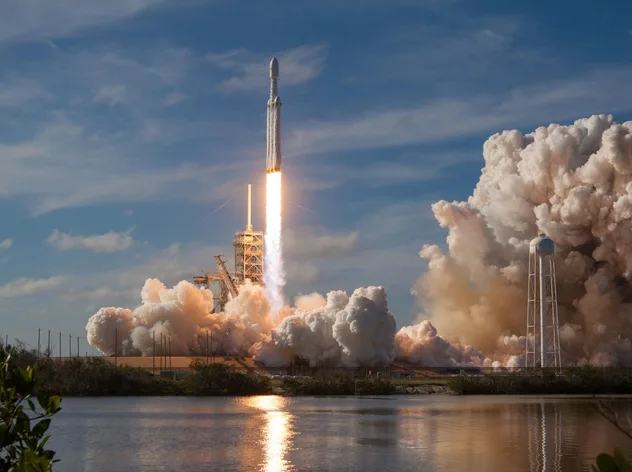
Falcon 9 / Starlink 15-18 — 27 Starlink satellites from Vandenberg SLC-4E on Friday, Falcon 9's 700th flight; booster B1093's 18th landed on Of Course I Still Love You.
Electron / The Sea God Surveys (iQPS Launch 9) — Slipped 41 minutes deeper into its window, now NET Monday 2 November at 16:41 UTC.
What people are saying
Mark Carney — In a Politico interview recorded in Montreal on Thursday 30 October, after a Canada-EU summit, the Canadian prime minister said his country has not tied its defences to a satellite system a billionaire could decide to switch off, and that Ottawa's own low Earth orbit constellation should be working in 2028, with Europe's coming a few years after. He offered to bridge or pool the two. He named neither Starlink nor Elon Musk, but agreed when an interviewer raised what happened with Ukraine.
The argument over whether a commercial constellation can be treated as national infrastructure keeps widening, and this is a head of government saying out loud what European operators have been pitching for weeks. Neither SpaceX nor Musk has answered publicly; Musk's standing line is that Starshield is owned and controlled by the US government, with any limits set by the military. TeslaNorth
News
Haolong — the winged cargo vehicle China picked in 2024 to supplement its Tianzhou freighters, now has a launcher: LandSpace won the tender announced on 28 October at 95 million yuan, with CAS Space runner-up at 100 million on the Kinetica-2. Tiangong logistics stops being a one-vendor business, and LandSpace's reusable Zhuque-3 picks up a flagship customer that needs a big fairing. In orbit the spaceplane is roughly 10 metres by 8 metres, and no more than 7,000 kilograms sitting on the rocket. China in Space
TLM-1 — Turkey's first lunar orbiter entered environmental testing this week, beginning in a thermal vacuum chamber, ahead of a Falcon 9 launch booked between April and June 2027, with April the aim. If it arrives, Turkey becomes the ninth sovereign nation operating a payload at the Moon, and does it with hardware built almost entirely at home rather than bought in. The roughly 3.6 tonne spacecraft is designed for at least five months in a 100 km circular polar orbit, with 56 of its 65 elements made in Turkey, and ends with a controlled impact. Spaceflight Now
FCC opens 25 MHz to auction with satellites riding second. Commissioners voted on Friday 30 October to start a rulemaking that would auction the 1675–1695 MHz and 2020–2025 MHz bands for terrestrial 5G, while letting satellite direct-to-device services in as a secondary user of the same frequencies. It is the regulator's answer to the fight over satellite-to-phone spectrum: offer operators new bands instead of forcing them into the ones the carriers want kept clean. AT&T, T-Mobile and Verizon have asked the agency to keep satellites out of 290 MHz of mid-band; the FCC wants up to 400 MHz in commercial use by 2028. SatNews
Pulsar — Xona's first six low-orbit navigation satellites, launched on the Bandwagon-5 rideshare on 20 October, are in orbit, and the company's chief executive used a Silicon Valley panel to argue that American resilience against GPS jamming now quietly rests on Chinese signals. A commercial navigation fleet is a new category of spacecraft to follow, and the dependency claim is both the sales pitch and the policy fight behind it. SatNews
“It’s actually worse to have bad location than no location.”
City Labs — which flew what it calls the first commercial nuclear satellite in July, is preparing an FAA application to carry far more tritium per mission, aimed at keeping landers alive through the two-week lunar night without hauling batteries. FAA payload authorisation is the quiet gate anything radioactive has to pass before it flies commercially, and this is the first serious attempt to widen it since the rules changed in 2019. The BOHR demonstrator carried 20 curies under a permit written for 10,000; the new request is 10 million curies, which the company equates to 300 watts of heat. SatNews
One takeaway
Kinetica 2 / SpaceSail Polar Group — China's Kinetica 2 is listed Go for Tuesday 3 November with a SpaceSail polar batch, lifting at 00:10 UTC inside a window running 00:05 to 00:33 UTC. Chinese launches rarely give you a clock time this tight in advance, and this is a young vehicle still proving itself rather than a workhorse, so it is the one worth being awake for this week. Space Launch Now