A house newsletter · daily · researched and written by the Kurzia AI
Friday 13 November 2026 · Issue 51 · 4 min read
Flight 15 on the pad for a double catch, Vulcan back after nine months, Hera circling Didymos
What's hot
TeslaNorth · today
Ship 42 rolls to the pad for the double catch
Takeaway: window opening at 22:45 UTC
SpaceX moved the upper stage, Ship 42, out to the Starbase pad on Thursday and its Flight 15 page still targets Friday 13 November, pending regulatory approval, with a 75-minute window opening at 22:45 UTC. The plan has Super Heavy coming back to the tower minutes after liftoff and the ship following after roughly 14 orbits spanning more than 22 hours, so the two catches are a day apart, not back to back. Along the way it is due to release 26 Starlink V3 satellites, three of them carrying cameras to look at the heat shield.
This is the flight the whole beat has been waiting on: a booster catch is now routine-ish, a ship catch has never been tried. A rollout is a preparation step, not a clearance, so treat the date as still conditional. Ground testing behind it: all 33 booster engines fired in October, then a six-engine static fire of Ship 42 and a single-engine firing standing in for the deorbit burn. The flight plan keeps ocean options open if a safe return home is not possible.
Flew
Falcon 9 | USSF-627 — launched successfully for the US Space Force.
Mir | Demo Flight — gave up its 05:00 UTC Friday slot and is now NET Monday 30 November, with the date no longer firm.
Kuaizhou 11 — missed its Thursday 19:50 UTC window and is now NET Monday 30 November, with the payload still unannounced.
What people are saying
Ars Technica · yesterday
Berger takes apart AST's "simple" rocket pitch
Takeaway: $1.3 billion to Firefly
At an hour-long event on Thursday, AST SpaceMobile chief Abel Avellan described Blacklift: three stages, all-composite tanks, a reusable first stage, 20 tonnes to low Earth orbit, two launches a month from the old Antares pad at Wallops, flying in 2028. Eric Berger's write-up for Ars Technica says that timeline is not credible, and that Avellan's claim that engines are 80 percent of a rocket's development does not hold: Firefly's Miranda first-stage engine has not finished qualification or flown, and almost nothing is public about the Vira upper-stage engine.
You have watched the launch crunch push a satellite operator into becoming a launch company. This is the first serious technical reality check on that plan, and it is the argument on the timelines this morning. AST is committing $1.3 billion to Firefly for engines for the first three flights plus a manufacturing licence, against about $2.8 billion in unrestricted cash at the end of September; Berger notes Rocket Lab hit two setbacks this year with Neutron's composite tanks.
SatNews · yesterday
Kyiv says Starshield is cutting off fast drones again
Takeaway: above 160 kilometres per hour
Ukrainian president Volodymyr Zelenskyy said on Thursday 12 November that military units have seen days of disruption to Starshield, SpaceX's encrypted government and defence version of its low Earth orbit network, with terminals losing the satellite link above 160 kilometres per hour. This is a claim from Kyiv and is not confirmed: neither SpaceX nor the US government has commented officially, per SatNews.
Who controls a commercial constellation in a war is the policy argument that keeps coming back, and it feeds directly into why operators elsewhere are shopping for alternatives to Starlink. SatNews notes an earlier Starshield disruption in October that ran about a week and a half before connectivity came back, and that this one coincided with US envoys arriving in Moscow.
News
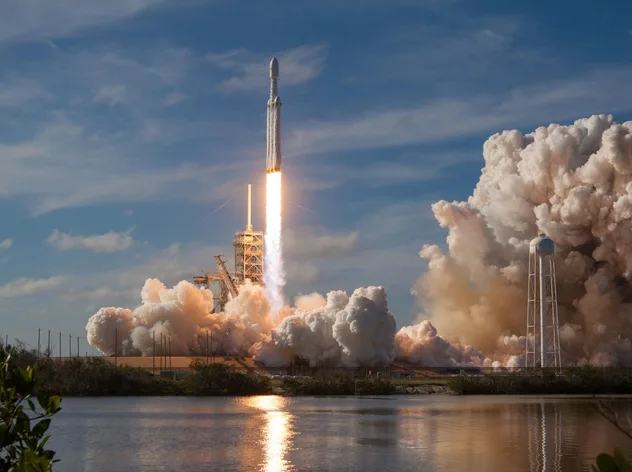
Vulcan Leo 1 — has been rolled out to Space Launch Complex 41 at Cape Canaveral for a Friday launch carrying 40 Amazon Leo broadband satellites, ending a nine-month stand-down over a problem with the solid rocket boosters. It is the vehicle both Amazon and the Space Force have been waiting on, and the first proof that the second launcher in the US heavy class is back. Aviation Week's Irene Klotz reports this is the fifth Vulcan to fly; it opens a 38-launch deal covering more than 1,500 Amazon satellites. SpaceWatch.Global
Hera — has arrived at the Didymos–Dimorphos pair and is observing from 30 to 25 km, crawling at 12 cm per second and firing thrusters every three to four days to turn 90 degrees, because the gravity is far too weak for a circular orbit. This is the follow-up to NASA's DART impact finally on station: the survey that says what a deflected asteroid actually looks like. The detailed phase begins in December at about 20 km, before the Juventas and Milani cubesats are released; Robert Zimmerman notes post-impact observations put Dimorphos's orbit about 33 minutes shorter. Starlust
“During this phase our images will reveal for the first time what a small asteroid looks like globally”
BepiColombo — is scheduled to enter orbit around Mercury on Saturday 21 November, eight years after launching from French Guiana on 20 October 2018, which would make it the second mission to orbit the planet after NASA's MESSENGER and the first to arrive as two spacecraft. After a long cruise and six flybys, this is the arrival to put in the diary; the two orbiters then go their separate ways. JAXA's Mio and ESA's Mercury Planetary Orbiter are due to separate on 9–10 December, with science starting in April 2027 for a nominal year. Starlust
NASA OIG Top Challenges report — landed on 12 November and lists five: putting people on the Moon, holding a US presence in low Earth orbit through the station's retirement, running major programmes, cybersecurity, and keeping mission-critical capabilities going. This is the list that decides what gets audited next year, and it flags exactly the items on the Artemis critical path. On the Moon it points at the human landing systems and next-generation spacesuits; on low Earth orbit it warns the transition needs real money and reliable crew and cargo transport. NASA Watch
“The Agency’s shift toward more service-based commercial acquisitions offers potential benefits but also demands heightened oversight to control costs and mitigate risks.”
Benjamin Flores — takes office as Texas land commissioner on 19 January and, his chief of staff Alex Martinez told Texas Monthly, will ask the attorney general whether the spaceflight exemption that lets SpaceX close the Boca Chica beach is constitutional. SpaceX's federal permits do not allow launching with the beach open, so an adverse opinion and the court fight that would follow is a real threat to the Starbase cadence you watch. The law dates from 2013; Robert Zimmerman argues it makes the Pecan Island site in Louisiana more urgent for SpaceX. Behind The Black
Hyperbola-3 — now has most of iSpace's attention, with chairman Peng Xiaobo telling Hong Kong's Wen Wei Po on 9 November that the small Hyperbola-1 keeps only a reduced team and existing contracts. The partly reusable Hyperbola-3 has not flown. Another Chinese operator betting the company on reuse, and a reminder of how far off these first landings are. Its methane-oxygen engines have only been fired singly on stands, never with a stage attached; Hyperbola-1 flew eight times from July 2019 for four orbital successes and has been grounded since. China in Space
MaiaSpace — is still the only European Launcher Challenge winner without a signed contract, because it asked to be paid through subsidised launch services rather than development co-funding, ESA space transportation director Géraldine Naja explained at a briefing on 22 October. Europe's answer to the small-launcher gap is already slower than announced, and three weeks on the signature has still not been reported. MaiaSpace's €183.4 million is all in the launch-service pot; ESA signed €543.6 million combined with Isar Aerospace, RFA and PLD Space on 27 August. European Spaceflight
“MaiaSpace is the only one of the challengers who has chosen to be supported in terms of launch contracts rather than in technical development”
GSLV-F19 — has its cryogenic third-stage engine: ISRO announced on 10 November that the flight acceptance test at the propulsion complex in Mahendragiri ran 200 seconds with performance matching predictions. The engine goes on the flight carrying the NVS-04 navigation satellite. India's NavIC rebuild is moving quickly after NVS-03, and this is the test that normally sets the launch date. It will be the GSLV's 21st mission; NVS-03 reached its final geosynchronous orbit after four orbit-raising burns following the 30 October launch. Starlust
Building the Future — is SpaceX's 12 November announcement of more than $74 billion in planned compute investment: up to $24 billion near the Port of Brownsville, generating its own electricity, and about $50 billion in Cochise County, Arizona, with nine buildings, up to 6 GW of power and 24 GWh of batteries, construction targeted for 2027. This is the land, power and tax fight that now sits alongside Starship operations at the same site, and the figures are SpaceX's own. It has paid $40 million so far toward a roughly $220 million gap in Brownsville's water projects, and is negotiating tax deals with the City of Starbase and Cameron County. SpaceAndSky
OSSIE-D — is UARX Space's orbital transfer vehicle, built in Spain and released from a Falcon 9 using the company's own SAU&RON 24 separation system; partner DHV Technology says the full electrical power subsystem it supplied, from solar arrays to battery, is working nominally in orbit. Small European in-space logistics is where a lot of rideshare payloads will end up, and this is a supplier chain proving itself rather than a paper mission. The companies describe it as a first for one firm providing both the tug and the separation system on the same mission; the figures and claims come from their own announcement. SpaceNews
Orbital Matter — says it 3D-printed a rigid hollow boom 32.5 centimetres long directly in the vacuum outside its satellite, and that the boom then extended to help deploy a stowed solar array. Building structures in orbit rather than folding them into a fairing is the thread running through this autumn's in-space assembly demos, and this is the manufacturing half of it. The company frames the test as a step toward making spacecraft structures in orbit; the report is brief and gives no mass or satellite name. SpaceWatch.Global
One takeaway
Set an alarm for 17:54 UTC on Friday, before the Starship one. Vulcan's return to flight is the first thing on today's card: liftoff is set for 17:54 UTC on Friday 13 November, with the window closing at 18:23 UTC and the mission currently go.
If you only watch one stream today, note this one comes first and is short: a 29-minute window, and a vehicle that has not flown since the winter. The Starship attempt follows later the same evening, so a quiet afternoon is unlikely. Space Launch Now